To rank in Google AI Overviews, your page must be indexed, eligible to show a snippet, and allowed in Search Console’s new generative AI setting. It also needs to rank well for the question and its related sub-questions, and answer them with original, trustworthy content.
There is no secret trick. AI Overviews pull from the same index and ranking systems as normal Google Search. So the work is good SEO, done with AI answers in mind.
This guide covers 12 steps, our own test of Indian search queries, why your site may not be showing, and the myths you can ignore.
Want your business to appear in Google AI Overviews?
Table of Contents
What are Google AI Overviews?

Google AI Overviews are AI-generated summaries at the top of search results that answer a question and link to the websites used as sources.
They now reach a huge audience: Google’s AI Overview has 2.5 billion users (Google).
They matter even more in India. AI Overviews appear for 26.8% of keywords in India, against 20.5% in the US (Ahrefs). About 81% of AI Overview queries happen on mobile (WordStream).
How does Google choose sources for AI Overviews?
Google chooses AI Overview sources using its core Search ranking systems, then picks the pages that best support each part of the answer.
Google describes two techniques (Google Search Central).
1. Retrieval-augmented generation (RAG). Google uses its ranking systems to pull relevant, up-to-date pages from its index, then builds the answer from them and shows links to those pages.
2. Query fan-out. Google runs several related searches at the same time to fill in the answer. Google’s own example: for “how to fix a lawn that’s full of weeds”, the fan-out searches might include “best herbicides for lawns” and “how to prevent weeds in lawn”.
What this means for you: you can be cited for a sub-question even when you don’t rank for the main query.
Google also says AEO and GEO are simply SEO. From Google Search’s point of view, optimising for AI search is optimising for the search experience.
How to rank in Google AI Overviews: 12 steps
Step 1: Check your Search Console generative AI setting
This is the newest requirement, and the one most guides miss.
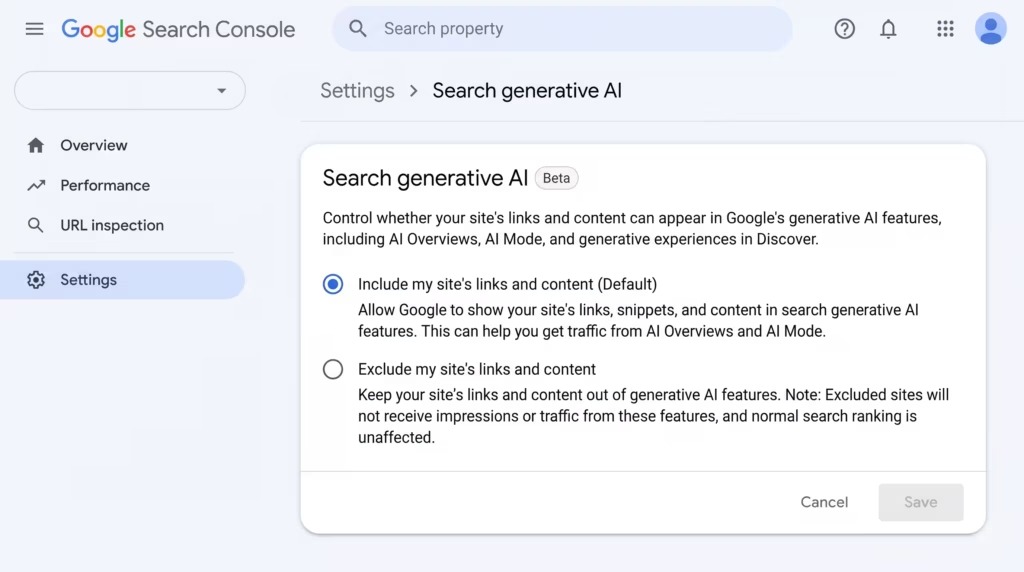
As of 31 August 2026, Google has rolled out a “Search generative AI” control to all websites. It controls whether your site can appear in AI Overviews, AI Mode and the AI features in Google Discover.
How to check it:
- Open Google Search Console.
- Go to Settings → Search generative AI.
- Make sure “Include my site’s links and content” is selected.
“Include” is the default for all properties. But if someone on your team changed it, your site won’t appear in AI features at all.
Step 2: Make sure your page can be indexed and shown with a snippet
To be eligible, a page must be indexed and allowed to show a snippet in Google Search.
Quick checks:
- Run the page through Search Console’s URL Inspection tool.
- Remove any noindex tag.
- Remove nosnippet, or a max-snippet limit that is too low. These tags limit what Google can show from your page in Search, including in AI features.
- Allow crawling in robots.txt, and at your CDN or hosting provider.
Step 3: Target questions that actually trigger AI Overviews
AI Overviews show up mostly for informational, long, question-style searches.
- Intent: 21.4% of informational keywords trigger an AI Overview, against only 2.1% of transactional keywords (Ahrefs).
- Length: 7+ word queries trigger AI Overviews 46.4% of the time, against 9.5% for one-word queries.
- Questions: about 25% of keywords that trigger AI Overviews start with a question word like how, what or why (Serpstat).
Industry matters too. Health queries trigger AI Overviews 60.7% of the time. Local services trigger them only 2.2% of the time (NP Digital).
Tip for Indian businesses: also test Hindi and Hinglish versions of your customers’ questions. For example: “SEO kitne din mein kaam karta hai”. Fewer pages answer these well, so they can be easier to win.
Step 4: Rank in Google’s top 10
Your organic ranking is still the biggest single lever.
- A page at position 1 has a 58% chance of being cited, falling to 14% at position 10 (Growth Memo).
- 38% of AI Overview citations also rank in Google’s top 10 (Ahrefs).
In plain terms: better rankings mean more AI citations. But pages outside the top 10 still get cited, often through fan-out sub-queries.
Not sure where your pages rank today?
Step 5: Answer the question in the first two lines
Put a clear, complete answer directly under each heading.
Research across AI tools supports this:
- 44.2% of LLM citations come from the first 30% of a page’s text (Growth Memo).
- Pages with headlines that directly answer the question are cited 41% of the time, against 29% for loosely related headlines (Growth Memo).
Note: these studies cover AI tools such as ChatGPT. Google says to write for people, which matches: readers also want the answer first.
How to write it:
- Use the question as your H2. For example: “How long does SEO take?”
- Answer in one or two sentences, and name the subject. Write “SEO usually takes…”, not “It usually takes…”.
- Then explain, with examples, steps or a table.
Step 6: Cover the related questions people ask next
Because of query fan-out, one strong page should cover the main question and its natural follow-ups.
For “how to rank in AI Overviews”, the follow-ups include:
- How long does it take?
- Why isn’t my site showing?
- Do I need schema?
- Can I opt out?
But don’t overdo it. Google warns that creating separate pages for every query variation, mainly to manipulate rankings or AI answers, breaks its scaled content abuse policy.
The rule: one complete page per topic, not twenty thin ones.
Step 7: Add original facts, data and first-hand experience
This is the step that matters most long term. Google says creating unique, compelling and useful content will likely influence your AI search presence more than any other recommendation in its guide.
Google contrasts two kinds of content. Commodity content, such as “7 Tips for First-Time Homebuyers”, repeats common knowledge. Non-commodity content, such as an expert’s first-hand story, offers insight that goes beyond the ordinary.
The data supports this:
- AI Overview-cited articles cover 62% more facts than articles that aren’t cited (Surfer).
- Adding statistics and citations can increase AI visibility by 40% (Aggarwal et al., 2024).
What to add:
- Your own results, numbers and case studies.
- Real examples from Indian clients and markets.
- Prices in rupees, local regulations and local platforms.
- A clear opinion, backed by evidence.
Step 8: Build trust on your site and beyond it
AI systems prefer sources they can trust, and much of that trust is earned on other websites.
- Third-party mentions: brands are 6.5 times more likely to be cited through third-party sources than their own domains, across AI search (AirOps).
- Video and forums: in AI Overviews specifically, YouTube is the most-cited source at 21.1%, followed by Reddit at 18.5% (Ahrefs).
- Reviews: in ChatGPT, sites with Trustpilot, G2 or similar review profiles are 3 times more likely to be chosen as a source (SE Ranking).
Warning: don’t buy fake mentions. Google says seeking inauthentic mentions doesn’t help, and its spam systems are designed to catch it.
On your own site:
- Show a named author with real credentials.
- Link to your sources.
- Add an “About” page and real contact details.
Need more reviews and mentions?
Step 9: Keep your content fresh
Across AI tools, 75% of the pages LLMs cite were updated within the last year (Seer Interactive).
What to do:
- Review your key pages every 3 to 6 months.
- Update statistics, prices and screenshots.
- Show a visible “Last updated” date.
- Don’t change the date without changing the content.
Step 10: Add helpful images and videos
AI search features can show relevant images and videos, which gives you more chances to appear beyond a plain link.
What to do:
- Use original images, with descriptive alt text.
- Embed a short YouTube explainer on key pages. YouTube is the most-cited domain in AI Overviews.
- Add a summary table where it helps readers.
Step 11: Make your site fast and mobile-friendly
Google lists a good page experience as part of the technical foundation. That includes displaying well on every device, loading quickly, and making the main content easy to find.
This matters most in India, where most AI Overview searches happen on mobile.
Quick fixes:
- Compress images (WebP, under 100 KB).
- Remove pop-ups that cover the content.
- Check your pages in PageSpeed Insights.
Is your website slow on mobile?
Step 12: Local and ecommerce businesses: update your Google profiles
AI answers can include product listings and local business information. Keeping Merchant Center and your Google Business Profile up to date helps you appear there.
For local businesses:
- Complete every field in your Google Business Profile.
- Keep your hours, services and photos current.
- Reply to every review.
How do you measure your AI Overview performance?

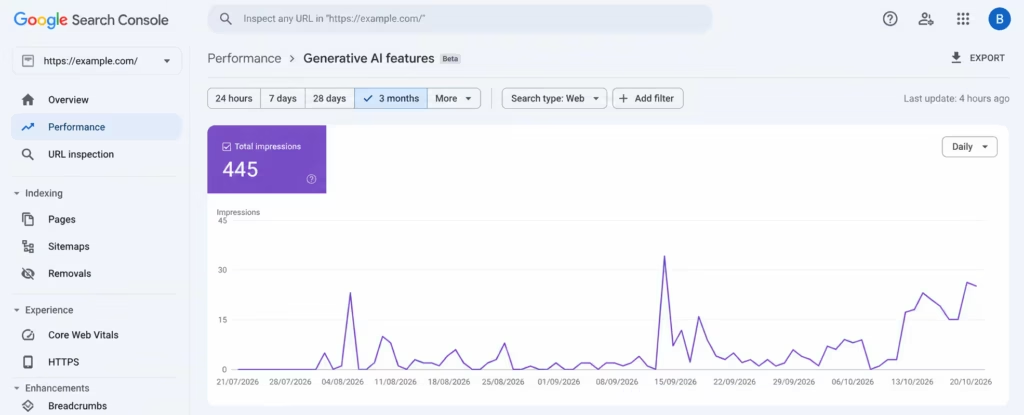
Use Search Console’s Generative AI performance report, which is free. It was rolled out to all websites on 31 August 2026.
What it shows:
- How your impressions from AI features change over time.
- Which pages get the most and fewest impressions.
- Where impressions come from, by device and country.
It currently covers AI Overviews and AI Mode.
Be careful with paid tools. Google warns that no third-party tool has access to its internal ranking or AI systems.
For tools that track ChatGPT, Gemini and Perplexity too, see our guide: Top 10 AI SEO Tools for AI Search in 2026.
Why isn’t my website showing in AI Overviews?
Most sites are missing from AI Overviews for one of these seven reasons. Work through them in order.
1. Your site is excluded in Search Console.
Check Settings → Search generative AI. Excluded sites get no traffic or impressions from these features.
2. Your page isn’t indexed.
Use the URL Inspection tool and request indexing.
3. You’ve blocked snippets.
Remove nosnippet or a low max-snippet setting.
4. The search doesn’t trigger an AI Overview.
AI Overviews only appear when Google decides they add something to classic Search, so they often don’t trigger. Check by searching the question yourself.
5. Your page ranks too low.
Improve the page so it reaches page one.
6. Your content repeats what everyone else says.
Add original data, examples and experience.
7. You don’t have enough impressions yet.
The Generative AI report won’t appear for sites without enough AI feature impressions.
AI Overview myths you can ignore
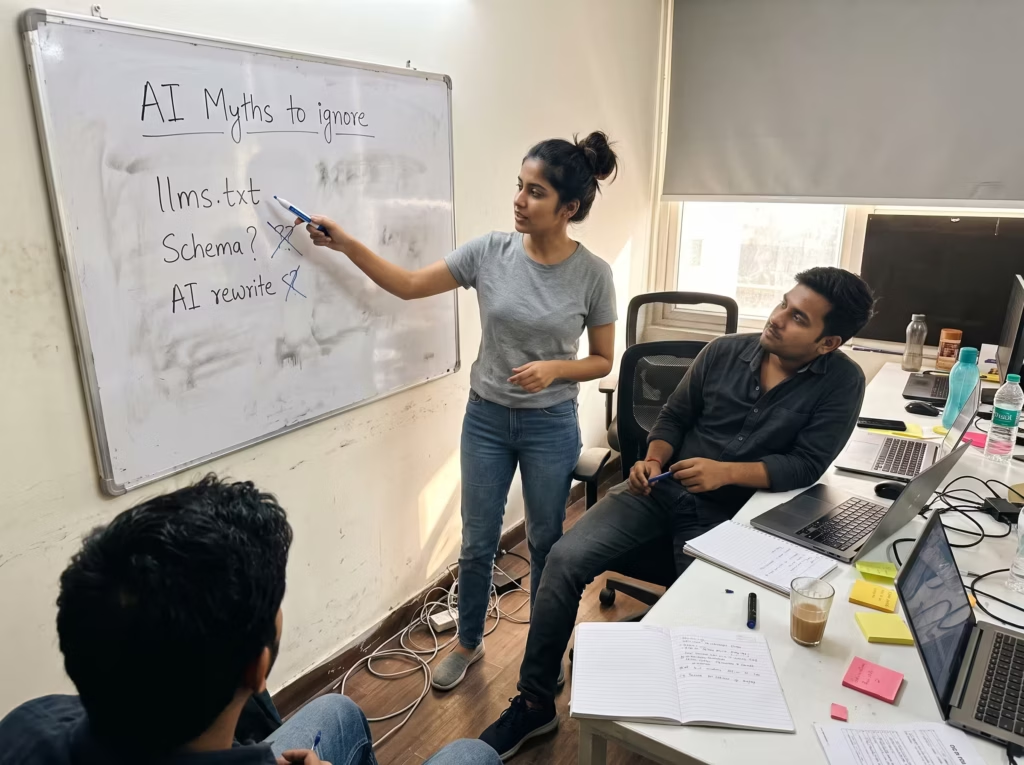
Google’s own guide lists these as things you don’t need to do.
Myth 1: You need an llms.txt file.
Google Search doesn’t use llms.txt files. Having one neither helps nor hurts your visibility.
Myth 2: You must “chunk” content into tiny pieces.
There’s no need. Google can understand multiple topics on one page, and there is no ideal page length.
Myth 3: You must rewrite content “for AI”.
AI systems understand synonyms and meaning, so you don’t need every keyword variation.
Myth 4: You need special schema.
No special schema is required. Standard structured data still helps with rich results.
Myth 5: AI Overview citations are stable.
AI Overview content changes 70% of the time for the same query (Ahrefs). Track trends over weeks, not single checks.
Do AI Overviews reduce website traffic?
Yes for many clicks, but being cited helps.
- AI Overviews reduce clicks to the top-ranking page by 58% (Ahrefs).
- Organic CTR is 35% higher when your brand is cited inside an AI Overview (Seer Interactive).
- Google says clicks from results pages with AI Overviews are higher quality, meaning visitors spend more time on the site.
The takeaway: the goal is no longer only to rank. It is to be the source Google quotes.
How long does it take to appear in AI Overviews?
There’s no fixed timeline. Google says even pages that meet every requirement aren’t guaranteed to be crawled, indexed or shown.
Recrawling a page can take anywhere from several days to several months. A page that already ranks on page one can be cited quickly. A new page on a new site usually needs months of SEO work first.
Can I stop my site from appearing in AI Overviews?
Yes. Set the Search Console control to Exclude. Content is usually excluded within one to two days of the change going live, though some can take longer.
For finer control, use nosnippet, data-nosnippet, max-snippet or noindex.
Before you exclude: excluded sites get no traffic or impressions from these features, and competitors’ content may appear instead.
Ready to show up in Google AI Overviews, ChatGPT and Gemini?
Frequently asked questions
How do I rank in Google AI Overviews?
Make sure your page is indexed, eligible for a snippet, and included in Search Console’s generative AI setting. Then rank well for the question and its related sub-questions, with original, trustworthy, answer-first content.
Is AI Overview optimisation different from SEO?
No. Google says optimising for its generative AI features is still SEO, because they rely on its core ranking systems.
Do I need schema markup for AI Overviews?
No. Google says no special schema is needed. Standard structured data still helps with rich results.
Does llms.txt help with Google AI Overviews?
No. Google Search ignores llms.txt files. They neither help nor hurt.
How can I see if my site appears in AI Overviews?
Open the Generative AI performance report in Google Search Console. It shows your AI Overview and AI Mode impressions by page, country and device.
Which searches show AI Overviews most often?
Long, informational, question-style searches. Queries of 7+ words trigger AI Overviews 46.4% of the time.
Can a small business in India appear in AI Overviews?
Yes. Google says AI features give more types of sites a chance to appear. Focus on local questions, original experience, and a complete Google Business Profile.
Why did my AI Overview citation disappear?
AI Overviews change often: content changes 70% of the time for the same query. Keep your page fresh and well ranked, and track trends over time.
About Bauer Bodoni
Bauer Bodoni is a digital marketing agency that helps businesses get found, get chosen and grow: on Google, on social media, and now inside AI answers from ChatGPT, Claude, Gemini and Google AI Overviews.
Our team handles strategy and execution under one roof:
- Search Engine Optimization
- Performance Marketing
- Social Media Marketing
- Website Development
- Creative Design
- Brand Development
- Product Promotion
- Influencer Partnerships
- Reputation Management
We also offer strategic business consulting and corporate event planning.
Every guide we publish is researched from primary sources and independent studies, dated, and updated when the facts change. We write to help you make better decisions, not to sell you tools.