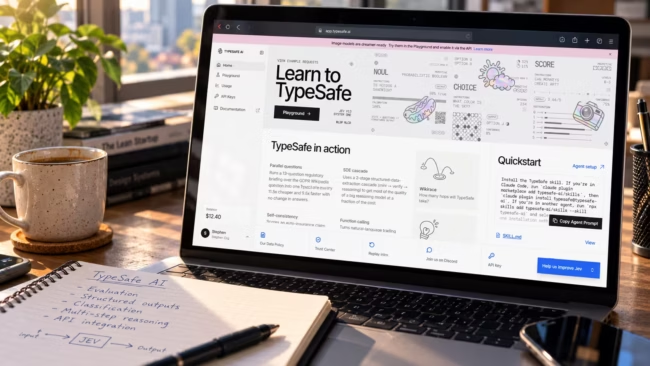
Jev AI is worth it if your software makes thousands of small sorting decisions a day. It is not a replacement for ChatGPT or Claude. Jev is a decision model from TypeSafe AI. It cannot write a single sentence. It reads text and returns a choice, a score or a yes/no probability.
Each answer comes with a confidence number your software can act on. Independent tests agree on three things. On OpenRouter’s Banking77 test, Jev reached 81.0% accuracy against 84.4% for Claude Opus 5, while running around 13 times faster and costing roughly 22 times less. Its confidence score is useful, but only after you tune it on your own data.
Key takeaways
- Jev AI is a decision model, not a chatbot.
- It is about 13x faster and 22x cheaper than Claude Opus 5 on sorting tasks.
- It is about 3 points less accurate than Claude Opus 5 on the same test.
- Its confidence score needs tuning on your own data.
- An opinion hidden in the input text can flip about 12% of its decisions.
- It costs US$0.042 per million input tokens, and output is free.
- No public test covers Hindi or other Indian languages yet.
Is Jev AI right for you? Quick answer
Use Jev AI when the answer is one item from a fixed list. Use ChatGPT or Claude when the answer has to be written.
| Your situation | Best pick |
| Sorting thousands of tickets or leads daily | Jev AI |
| Writing, research or coding | ChatGPT or Claude |
| You need top accuracy | Jev first, bigger model as backup |
| Decisions that move money | Not Jev alone |
| Text mostly in Hindi | Test first |
| Must self-host the model | An open alternative |
What is Jev AI?

Jev AI is a “System One” decision model made by TypeSafe AI. You send it some text and a typed question. It sends back a structured answer with probabilities, never a paragraph.
TypeSafe launched Jev on September 15 after operating in stealth for two years. The company was founded in 2024 by Diogo Almeida (CEO), Sasha Sheng (COO) and Erik Gafni (CTO). Almeida is a former OpenAI researcher and one of the co-inventors of RLHF and ChatGPT. The name is a reference to the economist William Stanley Jevons.
How does Jev AI work?
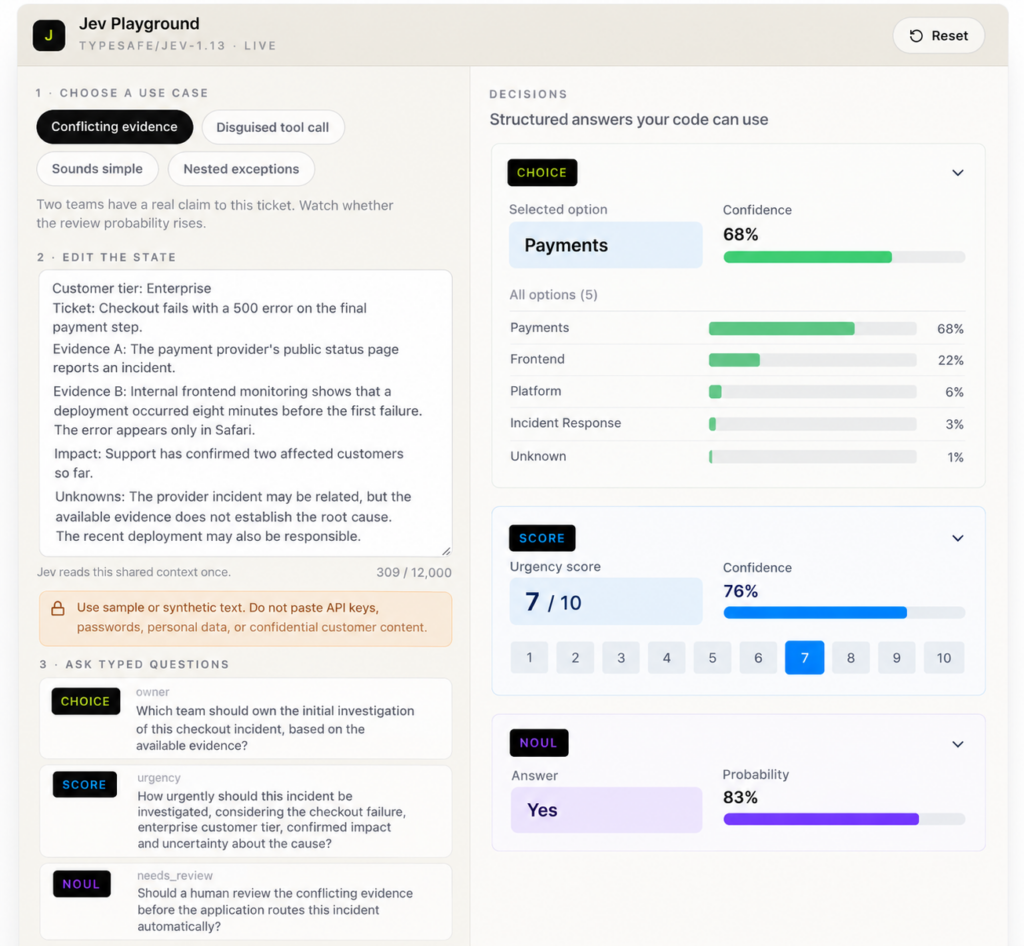
Jev AI answers three types of question, called Choice, Score and Noul.
| Type | What it answers |
| Choice | Which option? Up to 255 options |
| Score | Where on your scale? 2 to 10 levels |
| Noul | Is this true? One probability |
Choice and Score return a confidence value. Noul does not, because its probability is already the signal.
Can Jev AI write content?
No. Not a headline, not a sentence.
Does Jev AI hallucinate?
It cannot invent an answer outside your options. It can still pick the wrong option with high confidence.

What did independent tests of Jev AI find?
Independent tests put Jev AI level with mid-priced AI models and a few points behind the best frontier models, at a fraction of their cost. We ignored TypeSafe’s launch numbers and used only tests by people with nothing to sell.
1. OpenRouter (22 Sept 2026)
Tested on 3,080 banking messages. Median latency was 175 ms for Jev and 2,266 ms for Opus. Cost was $0.11 per 1,000 requests for Jev and $2.42 for Opus.
2. AY Automate (19 Sept 2026)
When Jev answered only items it was at least 0.80 confident about and passed the rest to GPT-5.6 Terra, accuracy matched Terra alone at 26 to 28 percent of Terra’s cost.
3. Christopher Lynch, transaction tagging
Jev took 92% less time than Opus and cost 97% less than Sonnet. It was confidently incorrect on 1.6% of transactions.
4. Social-science study, 7,977 items
Jev trailed the best of 19 LLMs on 14 of 15 tasks, by a median of 11.6 macro-F1 points.
5. Academic benchmark across 37 datasets
Jev reached 95 to 99% accuracy on IMDB, SST-2, HellaSwag and ARC, and 86.7% on Belebele across 122 languages.
What the tests add up to
- Speed and price are real. TypeSafe’s homepage claims 193.6 times faster and 444.6 times cheaper, based on its own workflows. No independent test reproduced those figures.
- Accuracy depends on the task. Task-specific results range from 62.6% on phishing to 95.4% on email sorting.
- The best setup is a cascade. At a 0.90 threshold, Jev handled 75.9% of requests, combined accuracy was 84.0%, and cost was $0.69 per 1,000 requests.
Our take: Jev AI is a useful tool wrapped in an inflated launch story. Buy the tool. Ignore the story.
Want AI tested on your own workflow before you spend?
Our consulting team runs real tests on real data.
Jev AI vs ChatGPT vs Claude: which wins each job?
Jev AI wins high-volume sorting and scoring. ChatGPT and Claude win anything that needs reasoning, writing or code.
| Job | Winner |
| Sorting thousands of items | Jev AI |
| Scoring leads or tickets | Jev AI |
| Routing work between AI models | Jev AI |
| Writing and research | ChatGPT |
| Coding and long documents | Claude |
| Multi-step reasoning | ChatGPT or Claude |
| Maths, dates, money | Plain code |
How teams combine them: Jev reads an incoming ticket and decides team, urgency and sentiment. Your code routes it. A chat model drafts the reply only when one is needed.
How marketing teams can use Jev AI
- SEO: Sort thousands of keywords by search intent in minutes. Pair it with a proper SEO strategy.
- Lead scoring: Rank incoming leads by buying intent before your performance marketing team follows up.
- Reviews: Flag angry reviews for fast replies as part of reputation management.
- Social comments: Route spam, questions and complaints on social media.
For the wider comparison, read our guide: Muse vs ChatGPT vs Claude.
How much does Jev AI cost in 2026?
Jev AI costs US$0.042 per million input tokens, and output is free. One million short decisions cost roughly US21toUS42.
| Workload | Jev AI vs alternative |
| 1,000 banking decisions | $0.11 vs $2.42 (Claude Opus 5) |
| 100 million tokens | $4.20 vs $26.00 (GPT-5.6 Luna) |
Running that 100-million-token workload on GPT-5.6 Luna comes to $26.00, and Jev cuts that cost by 97%. [layer3labs]
Three things change your real cost:
- Prompt size. You pay for your option descriptions on every call.
- Language. Spanish text costs 17 to 38% more input tokens than the same content in English. [github]
- Volume. At a few thousand decisions a month, you save a few dollars. At a million, the savings pay for the setup.
Is Jev AI’s confidence score reliable?
Jev AI’s confidence score is reliable for ranking which answers to trust, but not as an exact probability until you tune it.
- Medical test: Answers with a probability of 0.9 or higher were 93.4% accurate.
- Alignment study: Keeping the most confident half of decisions raised median accuracy from 0.793 to 0.933.
- UCLA audit: The middle of the four-class scale was overconfident, with a stated 0.750 against an observed 0.612.
- OpenRouter: Confidence is not a calibrated probability, so teams should pick and test a threshold on their own traffic.
The fix is cheap. One recommendation is to ship with 100 to 300 real labelled items and fit the temperature on them.
Where does Jev AI fail?
Jev AI fails most often when the input argues for an answer, when options are vague, and on reasoning-heavy tasks.
1. Opinions in the text sway it.
A single unverified opinion added to the input flips 12.1% of decisions and pushes 38% of confident answers below the 0.8 threshold that routes them to human review.
2. Vague options mislead it.
A router given option names without descriptions sent all 40 hard tasks to the cheap model, at a median confidence of 0.96.
3. Agent decisions get worse.
Using Jev to choose an agent’s next action cut median episode time but lowered task success.
4. It is not fully consistent.
Sending the same request twice changed the Score value on 38.5% of Score questions.
The good news: rewording a question stayed within 1.2 percentage points of the re-run baseline, and fields outside the schema never reached the model. [arxiv]
Why this matters: OpenAI, Cloudflare and AWS all launched decision models within three weeks of Jev, so these risks apply to the whole category.
Planning AI automation for your business?
Bauer Bodoni builds the strategy, the guardrails and the rollout.
Does Jev AI work in India and in Hindi?
Jev AI works from India through its API, but it is strongest in English. No public test covers Hindi yet.
TypeSafe says English is the primary language and that other languages are supported “but not as well”, without publishing numbers.
Spanish audit: accuracy dropped 3.0 to 6.4 points against English.
Russian audit: accuracy dropped 11.0 points on XNLI, and Cyrillic text used about 3 times more tokens.
Tips for Indian teams:
- Keep instructions and criteria in English.
- Budget extra tokens for Devanagari text.
- Test Hinglish separately. No benchmark covers it.
- From Europe, the hosted API took 344 to 345 ms per call. Time your own calls from India before you design around speed.
How do you get access to Jev AI?
You can use Jev AI through console.typesafe.ai, OpenRouter, Vercel AI Gateway or Cloudflare Workers AI. It is a hosted API only, so you cannot run it on your own server.
Sign-up status has changed since launch. One guide says TypeSafe removed the waiting list on 21 September 2026 and gives new accounts $5 of credit, about 120 million input tokens. Another reports that new sign-ups were paused on 22 September 2026. Check the console for the current status.
On privacy: TypeSafe says Jev is not trained on customer requests or responses, and it offers zero data retention to enterprise customers.
How do you use Jev AI safely? Six rules
To use Jev AI safely, test it on your own data, set a confidence floor, and keep exact work in code.
- Test first. Label 100 to 300 real items.
- Set a confidence floor. Automate only above it, often near 0.9.
- Treat input as untrusted. Customers can write text that argues for an answer.
- Describe every option. Bare labels cause confident mistakes.
- Keep exact work in code. Sums, dates, refunds and permissions stay in your software.
- Pin the version. Use jev-1.13.0, not jev-latest.
What are the best Jev AI alternatives?
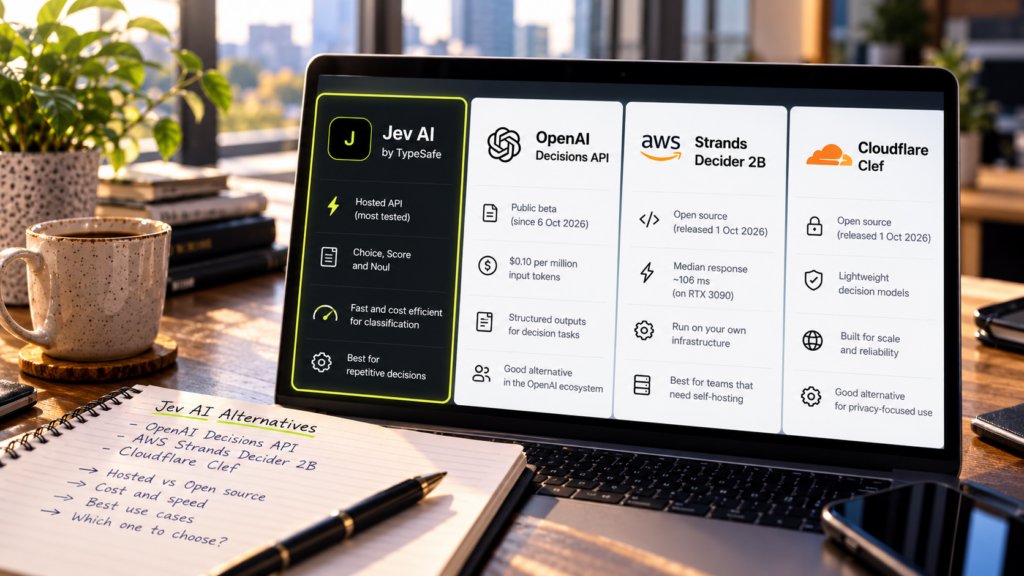
The main Jev AI alternatives are OpenAI’s Decisions API, Cloudflare Clef and AWS Strands Decider 2B.
- OpenAI Decisions API: In public beta since 6 October 2026, at $0.10 per million input tokens.
- AWS Strands Decider 2B: Open source, released 1 October 2026, with a median response of 106 ms on an Nvidia RTX 3090.
- Cloudflare Clef: Cloudflare open-sourced its Clef decision models the same day.
Pick Jev for the most-tested hosted option. Pick an open model when your data cannot leave your servers.
How we researched this Jev AI review
This review uses independent tests and research papers, not TypeSafe’s marketing. All sources were checked on 16 October 2026.
- What we read: OpenRouter’s benchmark, six arXiv studies, a UCLA audit, a Spanish-language audit, and funding reports.
- What we did not do: Run Jev on our own data. We will update this review when we do.
- What we left out: TypeSafe’s headline speed and cost multiples, which come from its own tests.
- A caution: Most of the arXiv papers are preprints, not yet peer-reviewed.
Where sources disagree:
TypeSafe now claims about one-third of Fortune 500 companies use it, though it has not named any of them.
Funding:
TypeSafe closed a roughly $870 million round valuing it at $7.5 billion, led by Andreessen Horowitz with Sequoia Capital, DCVC and angel investors. The money is real. The product is barely a month old.
Should your business invest in AI tools like Jev?
Most businesses do not need a decision model yet. They need one where repetitive sorting is eating a person’s day.
AI is also changing how customers find businesses. Search now includes Google AI Overviews and ChatGPT answers, not just ten blue links. Learn more in our guide: How to get your brand mentioned in ChatGPT and AI Overviews.
Bauer Bodoni is a digital marketing agency that helps brands grow in the age of AI search.
We cover SEO, performance marketing, website development, social media and brand development.
Jev AI: Frequently Asked Questions
What is Jev AI?
Jev AI is a decision model from TypeSafe AI, launched on 15 September 2026. It returns a choice, a score or a yes/no probability with confidence. It does not generate text.
Is Jev AI free?
Jev AI is not free, but it is cheap at US0.042permillioninputtokens,with free output.GuidesreportaUS5 sign-up credit, but terms have changed since launch.
Is Jev AI open source?
No. Jev AI is a closed, hosted API. Open alternatives include AWS Strands Decider 2B and Cloudflare Clef.
Can Jev AI replace ChatGPT?
No. Jev AI cannot write, summarize, code or chat. It handles the small sorting decisions inside a workflow. Most teams use both.
How accurate is Jev AI?
Jev AI scored 81.0% on OpenRouter’s banking test, against 84.4% for Claude Opus 5. It is level with mid-priced models and a few points behind frontier models.
How fast is Jev AI?
TypeSafe quotes 70 to 500 ms per request. OpenRouter measured a 175 ms median, against 2,266 ms for Claude Opus 5.
Is Jev AI’s confidence score reliable?
It reliably ranks which answers to trust, but exact values vary by task. Test it on 100 to 300 labelled items and set your own threshold.
Is Jev AI legit?
Yes. TypeSafe AI raised about $870 million at a $7.5 billion valuation on 9 October 2026, led by Andreessen Horowitz.
Does Jev AI work in Hindi?
Jev AI accepts non-English text, but no public test covers Hindi yet. Spanish accuracy dropped 3 to 6 points, so test your own Hindi or Hinglish data first.
What is Jev AI used for?
Ticket routing, lead scoring, content moderation, keyword sorting, choosing which AI model handles a task, and checking other AI outputs.
About the Author
Bauer Bodoni is a digital marketing agency that helps businesses get found, get chosen and grow, on Google, on social media, and now inside AI answers from ChatGPT, Claude and Google AI Overviews.
Our team handles strategy and execution under one roof:
- Search Engine Optimization
- Performance Marketing
- Social Media Marketing
- Website Development
- Creative Design
- Brand Development
- Product Promotion
- Influencer Partnerships
- Reputation Management
We also offer strategic business consulting and corporate event planning.Every guide we publish is researched from primary sources and independent tests, dated, and updated when the facts change. We write to help you make better decisions, not to sell you tools.